TRAVIS AIR FORCE BASE, Calif. — The acting head of the Defense Threat Reduction Agency recently completed strategic engagements across the Indo-Pacific, meeting with allies in South Korea and Japan to bolster cooperation against weapons of mass destruction threats in what Pentagon officials call the world's most strategically contested region.
Major General Lyle K. Drew visited Seoul, Tokyo, U.S. Indo-Pacific Command headquarters in Hawaii, Travis Air Force Base, and the Defense Language Institute over the course of two week, engaging with military leaders and technical specialists who form the backbone of America's WMD defense network in the Pacific. The multi-stop engagement spanned multiple time zones and four key locations, bringing the general face-to-face with personnel, partners, and infrastructure critical to countering chemical, biological, radiological, and nuclear threats.
Seoul: Shifting Security Responsibilities
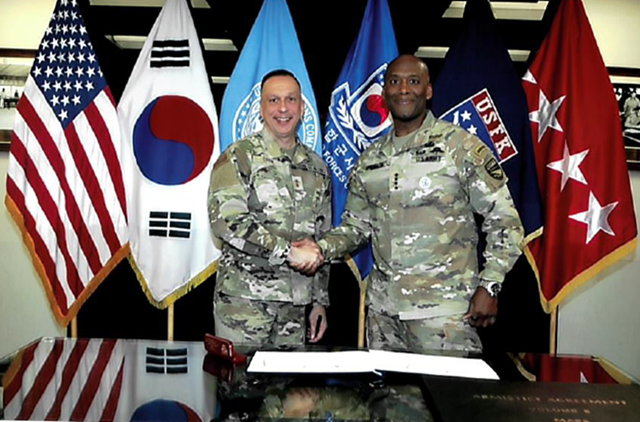
Drew's trip began in South Korea, where the security environment on the Korean Peninsula makes CBRN cooperation particularly urgent. The general met with General Xavier Brunson, commander of U.S. Forces Korea, to discuss integrating DTRA's specialized capabilities with the command's operational needs. Drew briefed Brunson on the full range of DTRA capabilities available to support USFK, including planning support, mission assurance assessments, and technical reachback services.
|
Figure 1: Major General Lyle Drew and General Xavier Brunson meets at United States Forces Korea (USFK) Headquarters in Camp Humphreys.
|
The discussions centered on a "burden-sharing" model aligned with the recently released 2026 National Defense Strategy. This approach prioritizes the integration of allied capabilities to ensure that while U.S. Forces Korea maintains regional stability, South Korean forces are increasingly equipped to take primary responsibility for conventional deterrence through DTRA's technical expertise.
The general also met with officials from South Korea's Arms Control and Verification Agency (KAVA). DTRA has been working to transfer high-end technical tools and verification expertise to South Korean partners through subject matter experts, empowering KAVA to take a primary role in managing WMD threats and arms control. Drew specifically praised KAVA's efforts to serve as a central coordinating entity across the Korean interagency.
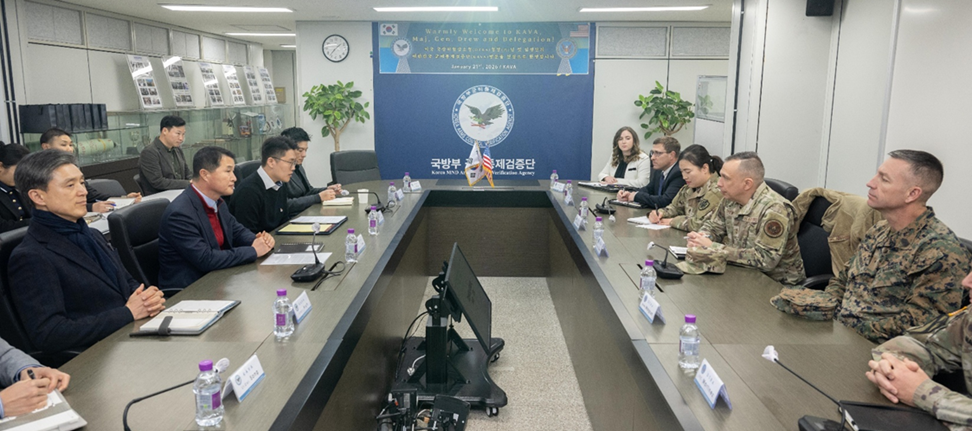 Figure 2: Major General Drew sits down with officials from South Korea's Arms Control and Verification Agency (KAVA).
A highlight of the Seoul visit was Drew's meeting with ROK Brigadier General Jong-yul Jun, commanding general of the ROK CBRN Defense Command, to celebrate successful capacity-building milestones and the formal integration of the Nuclear Characterization Team. This long-standing collaboration is designed to enhance South Korea's ability to independently manage and disable nuclear infrastructure in high-threat scenarios. ROK NCT members receive advanced mentoring in radiation detection, battle tracking, and decontamination procedures specifically tailored for real-world nuclear facility environments.
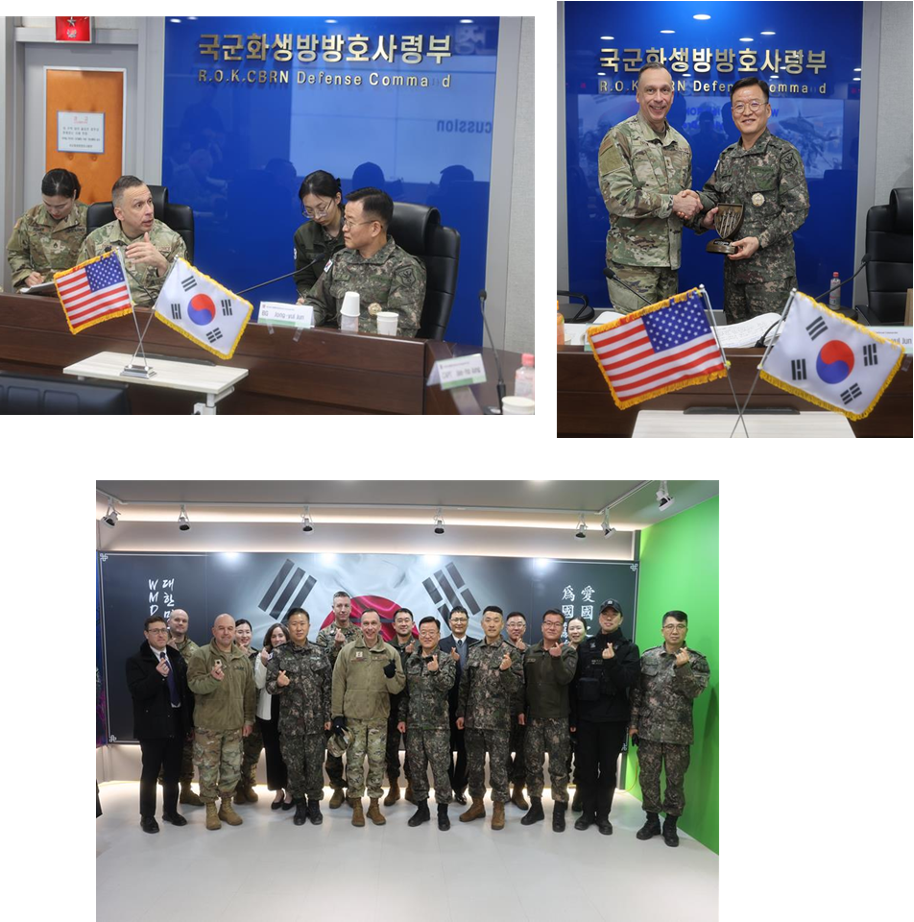
Figure 3: Top left: Major General Lyle Drew and Republic of Korea (ROK) Brigadier General Jong-yul Jun, commanding general of the ROK CBRN Defense Command hold collaborative talks. Top right: Major General Drew and Brigadier General Jong-yul Jun. Lower center: Members of ROK (Republic of Korea) Nuclear Characterization Team (NCT) are joined by DTRA Acting Director, Major General Lyle Drew. The NCT is a specialized unit within the South Korean CBRN Defense Command, comprised of Army, Navy, and Air Force personnel designed to detect, identify, and assess nuclear threats.
Japan: Expanding Technical Partnerships
After leaving Seoul, the DTRA leadership headed to Japan in a strategic effort to align with the shifting defense landscape in the Indo-Pacific. Yokota Air Base serves as a vital strategic hub for DTRA's Pacific Forward site, providing on-scene arms control verification and 24/7 technical reachback to monitor and mitigate WMD threats across the region.
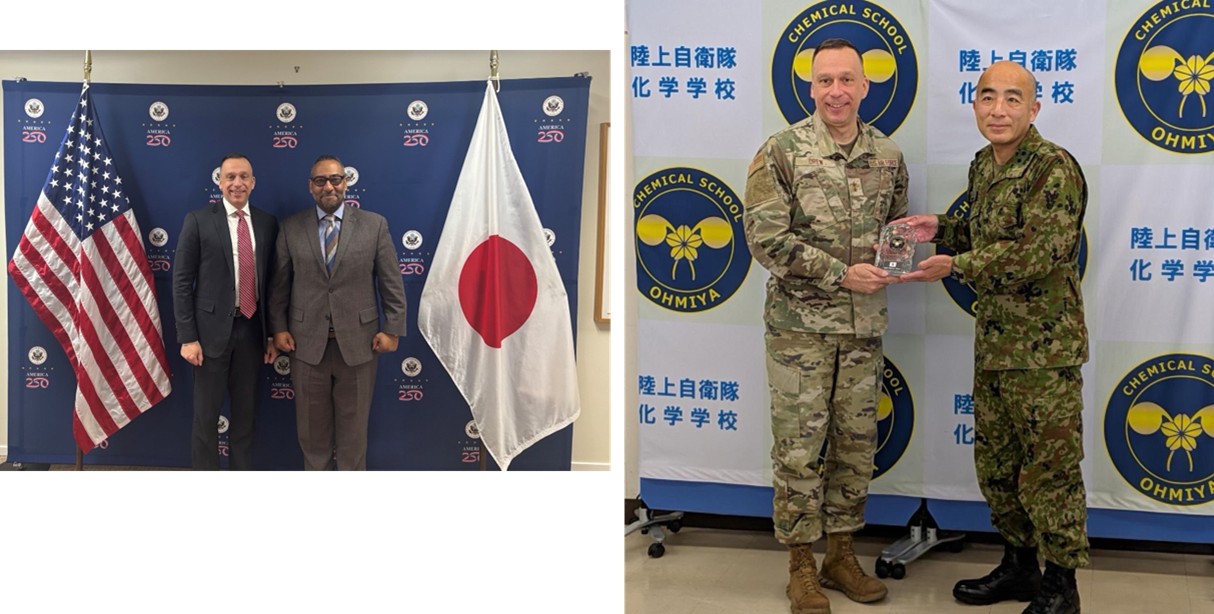
Drew held talks with Aaron D. Snipe, deputy chief of mission at the U.S. Embassy in Tokyo, exploring how Japan's increased defense commitments could create a more balanced security partnership. The general emphasized DTRA's role in providing the technical "connective tissue" required for this transition, leveraging Yokota Air Base as a vital hub for regional coordination and technical support.
|
Figure 4: Major General Lyle Drew meets with Aaron D. Snipe, deputy chief of mission at the U.S. Embassy in Tokyo,
Figure 5: Major General Lyle Drew and Major General Akira Murakami from the Japan Ground Self-Defense Force celebrate a JGSDF milestone.
|
The discussions included plans for a Senior Leader Education Seminar to integrate CBRN defense priorities into joint force operations—a proposal supported by Snipe for its high-level value. By aligning DTRA's specialized technical capabilities with Japan's growing defense aspirations, the agency aims to ensure that allies are not only willing but fully equipped to lead regional security initiatives.
In a historic first visit by DTRA leadership, Director Drew met with Major General Akira Murakami at Japan Ground Self-Defense Force Camp Omiya to congratulate the command on its official designation by the Organization for the Prohibition of Chemical Weapons. This milestone opens new doors for collaborative research and development, with both parties exploring expanded partnership through existing data exchange agreements to address emerging CBRN threats.
In a significant move toward deeper technical integration and information sharing, the DTRA acting director initiated efforts to bridge existing capability gaps by prioritizing joint operations and national security research with international allies. The move represents a significant step toward bridging existing capability gaps.
Operationalizing U.S. Forces Japan
In meetings with Lieutenant General Stephen Jost and other USFJ leadership, DTRA prioritized bridging support gaps as the command transitions toward a more operational, warfighting focus. Drew reaffirmed the agency's commitment to providing embedded subject matter expertise and mission assurance support, marking a significant step in establishing a closer working relationship to address regional counter-WMD requirements.
Japan's commitment to increased responsibility sharing allows DTRA to integrate technical expertise directly into the alliance, empowering the Japan Ground Self-Defense Force (JGSDF) to lead regional CBRN defense and ensuring long-term stability through a more balanced and capable defense architecture.
At Yokota Air Base, Drew engaged directly with the DTRA Pacific Forward team during an all-hands town hall to synchronize the forward-deployed staff with the agency's shifting strategic priorities. After a comprehensive tour of the facilities and evaluation of current mission requirements, he reinforced the site's critical importance within the Indo-Pacific theater. The general made clear that the status quo is insufficient—the team must evolve beyond traditional capacity-building to serve as a high-impact operational hub projecting DTRA's full suite of capabilities across the region.
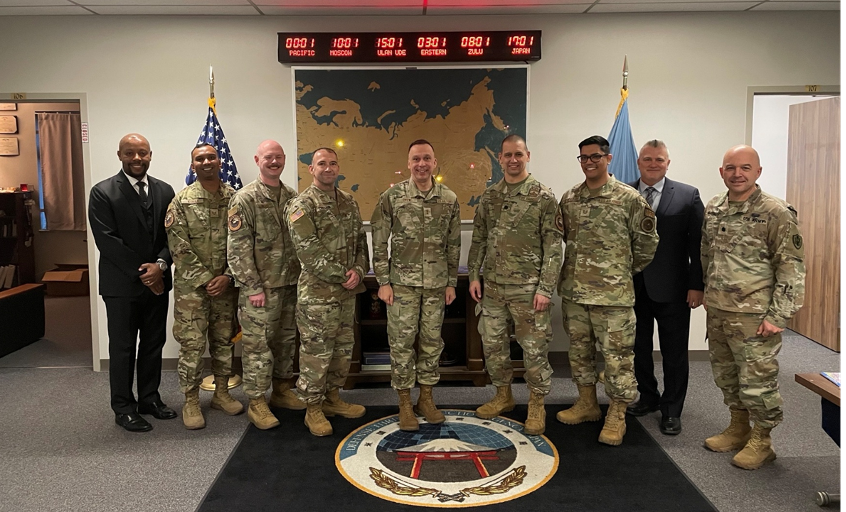
Figure 6: The DTRA Pacific Forward Team stands with Major General Drew after touring the facilities at Yokota Air Base.
Hawaii: Strategic Alignment with Indo-Pacific Command
Drew's mission in Hawaii focused on establishing deep operational synergy between DTRA and USINDOPACOM to ensure the command is fully equipped to counter WMD threats and prevail in high-end conflict. A primary objective was ensuring senior leaders thoroughly understand how to leverage DTRA's specialized capabilities, including mission assurance, counter WMD planning, and hard and deeply buried target defeat.
Throughout the engagements, Drew emphasized USINDOPACOM's status as a priority for the agency, a commitment formalized by delivery of the FY26 Posture Plan. Central to the dialogue was integration of DTRA subject matter expertise—including special activity advisors and technical reachback—directly into the theater's operational cycle.
By offering the full suite of DTRA's counter WMD, HDBT and treaty verification support, the mission sought to bridge critical capability gaps within the command staff. Drew also highlighted the availability of the Combatant Command Reachback team to work alongside USINDOPACOM planners to refine and develop specific theater requirements.
Before leaving Hawaii, Major General Drew took the opportunity to meet with the DTRA Pacific Technical Support Group (PTSG) to review their critical role in providing on-site technical expertise and mission support to the U.S. Indo-Pacific Command. During his talk, he emphasized their importance in building partner capacity through regional exercises designed to identify and interdict weapons of mass destruction.
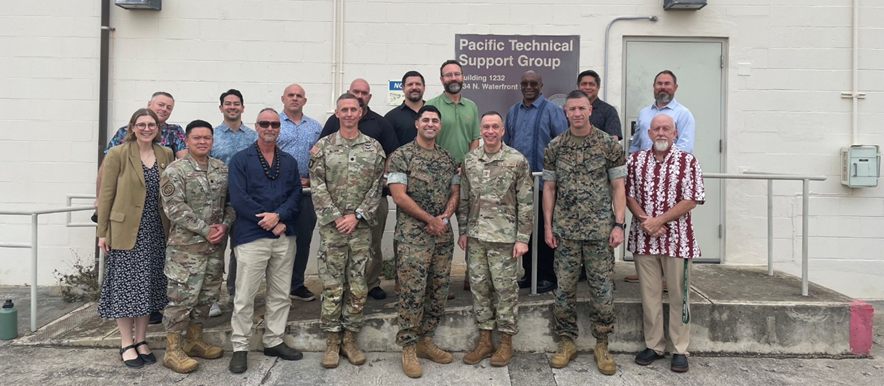 Figure 7: The DTRA Pacific Technical Support Group (PTSG) stands proudly with Major General Drew at Camp Smith, Hawaii. The PTSG serves a critical role in providing on-site technical expertise and mission support to the U.S. Indo-Pacific Command.
The visit prioritized the use of elite training from the Defense Nuclear Weapons School and comprehensive exercise planning to bolster collective readiness, serving as a strategic catalyst to operationalize the "Whole of DTRA" approach.
Travis: Where Strategy Meets Execution
The Indo-Pacific journey continued to the U.S. west coast at Travis Air Force Base, located approximately 50 miles northeast of San Francisco, where Drew met with personnel from DTRA's Geographically Separated Unit who transform high-level policy directives into operational reality. The permanent DTRA presence at Travis serves as the agency's primary West Coast operational hub and staging point for all Pacific theater missions.
"What we do here at Travis doesn't always make headlines, but it makes history," Drew told GSU personnel during his visit. "Every inspection team that deploys, every piece of specialized equipment that moves through this base, every coordination meeting that happens in these offices—all of it contributes directly to deterring the use of the world's most dangerous weapons."
The general toured GSU facilities and met with personnel from the 60th Air Mobility Wing, observing firsthand the complex logistics required to support DTRA's treaty verification missions. He met with inspection teams preparing for overseas deployments and received briefings on the unique challenges of moving sensitive detection equipment across vast Pacific distances.
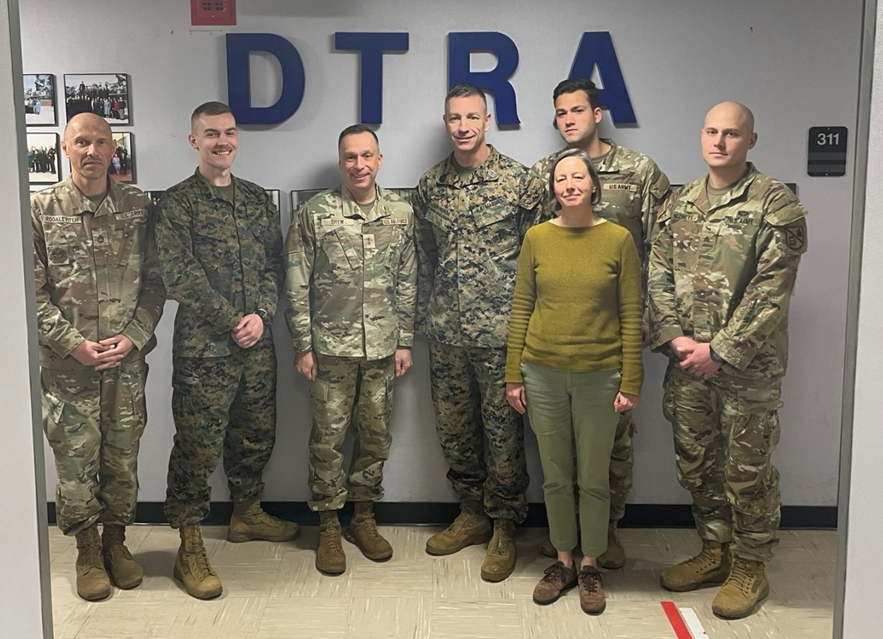
Figure 8: Major General Drew met with DTRA inspection teams at Travis Air Force base who shared the unique challenges of moving sensitive detection equipment across the Pacific. Pictured with the general are DTRA team members along with Airmen from the 60th Air Mobility Wing.
Concluding his trip in Monterey, Major General Drew met with leaders from the Defense Language Institute (DLI) to reaffirm the long-standing and productive partnership between the two organizations. He expressed deep appreciation for DLI’s highly qualified instructors, noting that DTRA linguists—including the 2024 OSD Language Professional of the Year—are consistently recognized as top performers. During the visit, Drew gained deeper insight into how this collaboration equips language-enabled specialists with the unique skills necessary to advance U.S. strategic interests and strengthen foreign partnerships. The engagement highlighted the critical role DLI plays in informing DTRA’s decision-making and preparing the next generation of interpreters for complex mission requirements.
The Human Element of Deterrence
Throughout the trip, Drew emphasized the human dimension of deterrence. At Travis, he spent considerable time in one-on-one conversations with junior enlisted personnel, technical specialists, and civilian contractors who form the operational backbone of DTRA's Pacific presence.
Senior Airman Marcus Rodriguez, a logistics specialist who coordinates sensitive shipments through Travis, recalled his conversation with the general. "He asked detailed questions about our processes, our challenges, what keeps us up at night," Rodriguez said. "He genuinely wanted to understand how the mission works at our level."
This emphasis on personnel readiness extends beyond U.S. forces. In both Seoul and Tokyo, Drew met with mid-level officers and technical specialists who will implement the enhanced cooperation agreements discussed at senior levels.
"Treaties and memoranda of understanding are important, but they're just paper," the general told personnel at Travis. "Real security cooperation happens when a Korean lieutenant and an American captain can pick up the phone, trust each other implicitly, and coordinate a response to an emerging threat. That's what we're building."
Evolving Mission in Changing Threat Environment
Drew's multi-location journey reflects DTRA's transformation from a research-focused organization to a fully integrated combat support agency. With an annual budget of almost $2 billion and operations in more than 100 countries, the agency has steadily expanded its operational role in response to evolving threats.
The shift has been driven by the changing nature of WMD proliferation. Nation-state actors with sophisticated infrastructure, proliferation concerns now include non-state actors, dual-use technologies, and potential biological threats emerging from both natural and artificial sources.
"The threat landscape has become more complex, more distributed, and more unpredictable," Drew said. "Our response has to be equally agile. That means being forward deployed, deeply integrated with combatant commands, and constantly engaged with international partners."
Looking Ahead
As the Indo-Pacific continues to command increasing attention in U.S. defense strategy, DTRA's presence in the region is poised to expand further. The agency is exploring enhanced capabilities for its forward-deployed elements, increased prepositioning of specialized equipment, and more frequent bilateral and multilateral exercises with regional partners.
Plans currently under development include a Pacific-focused CBRN conference to be hosted in Hawaii later this year, bringing together technical experts and military planners from across the region. DTRA is also working with USINDOPACOM to establish rapid-response protocols that could deploy specialized teams anywhere in the theater within 48 hours of an incident.
"This mission wasn't about conducting ceremonial visits," Drew said as he departed the Defense Language Institute for Washington, D.C. "It was about ensuring that every link in our chain—from the policymakers in D.C. to the allies in Seoul and Tokyo to the DTRA personnel serving across the globe —understands how they are aligned to the National Defense Strategy and ensure they are resourced to execute it at the speed of the warfighter."
He added: "The Indo-Pacific is not a future challenge. It's today's challenge. And the work being done by our teams at DTRA, often away from public attention, is what keeps Americans safe every single day."
The Defense Threat Reduction Agency, established in 1998, employs military, civilian personnel and contractor personnel worldwide to counter WMD threats through capabilities spanning reduction, elimination, and mitigation efforts. Travis Air Force Base, one of Geographically Separated Unit (GSU) locations, serves as DTRA's primary West Coast logistics and deployment hub, supporting operations throughout the Indo-Pacific region.
For more information about DTRA operations, visit www.dtra.mil or contact the DTRA Public Affairs Office.